

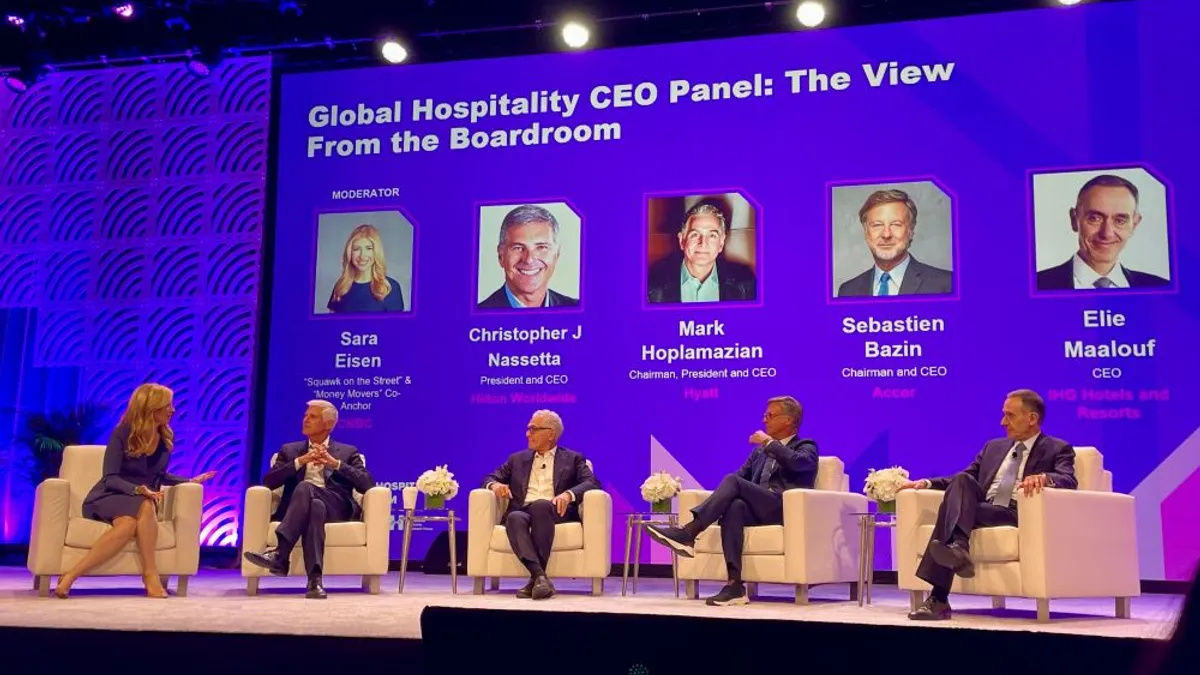
NEW YORK — Weakened international demand ahead of the busy summer travel season, the rapid acceleration of artificial intelligence and the impacts of an uncertain economic environment were top of mind for hotel CEOs at this year’s NYU International Hospitality Investment Forum in New York City.
During the annual event, chief executive officers from Hilton, Hyatt, Stonebridge, Accor and Aimbridge Hospitality discussed these topics, providing insights into how they expect the industry to fare for the remainder of 2026. Below are some of the top takeaways from CEOs at the event.
“Starting in the fourth quarter of last year and into the first quarter and second quarter [of 2026], you're starting to see a ‘C-shaped economy’: C for convergence, where, while the high-end is still doing well, you're starting to see the mid-chain scale segments, and even the lower-chain scale segments, come up."

Chris Nassetta
Hilton CEO
More on the economy:
Nassetta’s C-shaped economy hypothesis, which he also discussed during Hilton’s first-quarter earnings call in April, is a departure from the more widely referred to K-shaped economy, which purports that high-end consumers are thriving, while their lower-tier counterparts are not amid a growing wealth bifurcation.
Driving a C-shaped economy, Nassetta said, are multiple factors, including a business-friendly, tax-friendly and deregulatory environment, as well as a massive investment cycle, including for AI as well as infrastructure and data center construction. The current climate is highly stimulative, according to Nassetta, allowing more middle-class consumers to spend their money.
Other chief executives at the event noted that economic patterns reflect a K-shape, with high-tier segments continuing to outperform and some increased spending by middle- and lower-income households.
Stonebridge CEO Rob Smith said during a separate session that the hotel industry has been experiencing a K-shaped economy since COVID, but it’s not exclusively benefiting the luxury segment. Travelers are also demanding upper upscale accommodations and experiences, he said.
Despite that continued demand for experiences, hotel bookings for the FIFA World Cup — arguably one of the largest domestic events of the year — have tracked below initial expectations.
“International [tourists for the World Cup], that cake is baked; if they’re not on the books now, they’re not coming."
Rob Smith
Stonebridge CEO
More on travel demand:
Smith is cautiously optimistic for 2026, as he awaits the full effect of the World Cup on hotel business, he said. Domestic leisure travel remains strong, which could fill the gaps in international inbound visitation, according to Smith.
Hyatt CEO Mark Hoplamazian also said that for higher-end travelers, leisure travel has remained extremely strong, resulting in durable demand for his company.
Consumers’ desire for live sporting and entertainment events has driven continued travel demand, IHG Hotels & Resorts CEO Elie Maalouf noted. In fact, the more consumers intake digital, virtual and artificial experiences, the more they crave real-life experiences, Maalouf said.
On Monday, CoStar and Tourism Economics upgraded their full-year 2026 U.S. hotel RevPAR outlook amid confidence that hotels will see solid performance this summer.
“Probably a third, if not 40% of all my jobs under corporate, will be replaced by AI technology."
Sébastien Bazin
Accor CEO
More on AI’s anticipated impact on hotel labor:
Bazin, who recently announced he would be stepping down from the chief executive role no later than May 2028, said he feels the need to warn corporate workers that in 18 to 24 months, they will not be doing what they do today. But employees shouldn’t be afraid, because plenty of jobs will remain, just with different duties, he noted.
Hyatt’s Hoplamazian said that while he anticipates AI will have an impact on the hospitality laborforce, it will be lower than Bazin suggested.
Hyatt aims to utilize AI to optimize administrative tasks, allowing workers to interact more thoughtfully with guests, Hoplamazian said. Last year, Hyatt laid off 30% of its U.S. guest services and support teams, which some have speculated was a result of AI integration.
“We're looking to try to effectively use AI to amplify the humanity that’s in hospitality."
Mark Hoplamazian
Hyatt CEO
More on technology investment:
Similar to Hoplamazian, IHG’s Maalouf said he doesn’t think his organization will ever take the humanity out of hospitality, with AI being used to streamline administrative tasks.
Nassetta, meanwhile, said AI will enable Hilton to do things the company has only dreamt of in terms of the customer experience. New AI tools will enable Hilton to deliver exactly what the guest wants when they want it, he said.
In March, Hilton rolled out a generative AI-powered digital concierge to help customers plan trips at its hotels with conversational language. The company is among a slew of competitors investing in artificial intelligence for guest-facing tools as well as for products that benefit hotel owners and corporate employees.
Aimbridge Hospitality CEO Craig Smith said at the conference that AI is not a shiny penny, but rather the next and much bigger thing that will transform the hotel industry.
“You've got talent that’s hungry again, you’ve got people that want to travel … and AI is the biggest thing … if we capture it and take care of it, it's going to change our industry in many, many ways."
Craig Smith
Aimbridge Hospitality CEO
More on industry optimism:
A lot of the time, the hotel industry can hyper-focus on downward trends, Craig Smith added, saying that past the clouds, there’s a bounty of opportunities just waiting for hotel companies to take advantage of them.