

Dive Brief:
- U.S. hotel investment activity displayed “strong momentum” in the first quarter of 2026, with total transaction volume rising 14.4% year over year to $5.6 billion, largely driven by several luxury asset trades, according to a quarterly report from JLL.
- Domestic RevPAR increased 3.8% year over year in Q1 as bifurcation continued, with luxury (up 7.8%) outperforming the economy sector (down 2.1%), per the report.
- For 2026, the investment market outlook remains positive, with large-scale transactions expected to “lead the way,” per JLL. The report further notes that ongoing geopolitical uncertainty and private credit concerns have “not adversely impacted debt liquidity.”
Dive Insight:
JLL reported a total of 227 transactions in the first quarter, up 35% year over year. Single-asset transactions reached $5.4 billion, up 33% year over year, with five of those single assets trading at more than $100 million.
Still, total transaction volume is down 47% compared to the cyclical peak observed in 2022.
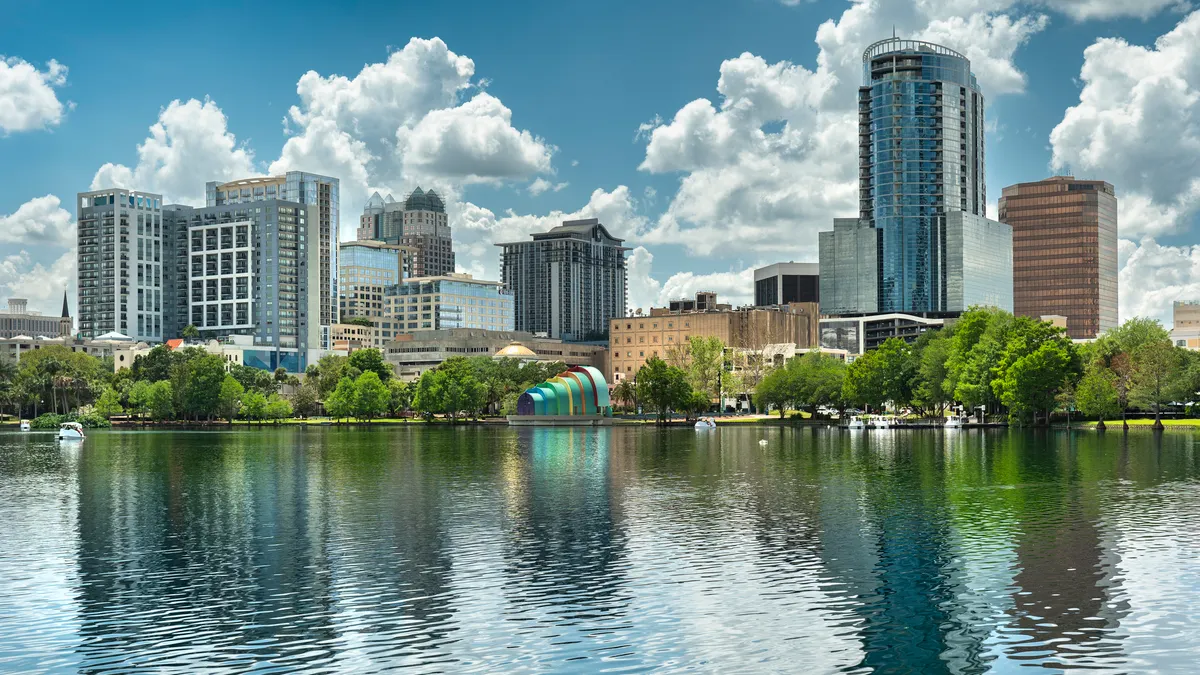
Orlando, Florida; New York City; and Jackson Hole, Wyoming, led transaction activity in Q1, at $842 million, $588 million and $362 million, respectively. Earlier this year, Host Hotels & Resorts sold the 444-key Four Seasons Resort Orlando and Residences Jackson Hole in Wyoming for a combined $1.1 billion. In New York City, Gencom acquired the 253-key Ritz-Carlton New York, Central Park for an undisclosed sum.
Private equity notably accounted for some of this growth, making up 34% of transactions in the quarter fueled by “stabilizing interest rates and favorable market dynamics.”
In its 2026 Global Hotel Investment Outlook, JLL predicted that private equity would be “back on the offense” and be more readily available to deploy capital. Institutional capital’s return to the sector is also a result of renewed confidence in hotels as an investment, which is seen as a resilient asset type, especially when compared to other asset types (like commercial), per the report.
Additionally, both full-service and select-service assets continue to trade at discounts to replacement cost.
Looking ahead, JLL predicts a “more optimistic environment for 2026” in part due to improved debt market conditions, which are expected to “facilitate a rise in high-value asset and portfolio-level sales.”
Moreover, a wealth bifurcation continues to shape investment strategy, with investors zeroing in on luxury assets as well as premium select-service and extended stay hotels. Luxury is benefiting from “resilient spending” by high-income travelers, while select-service hotels are known for their “efficient operating models” and durable returns.