

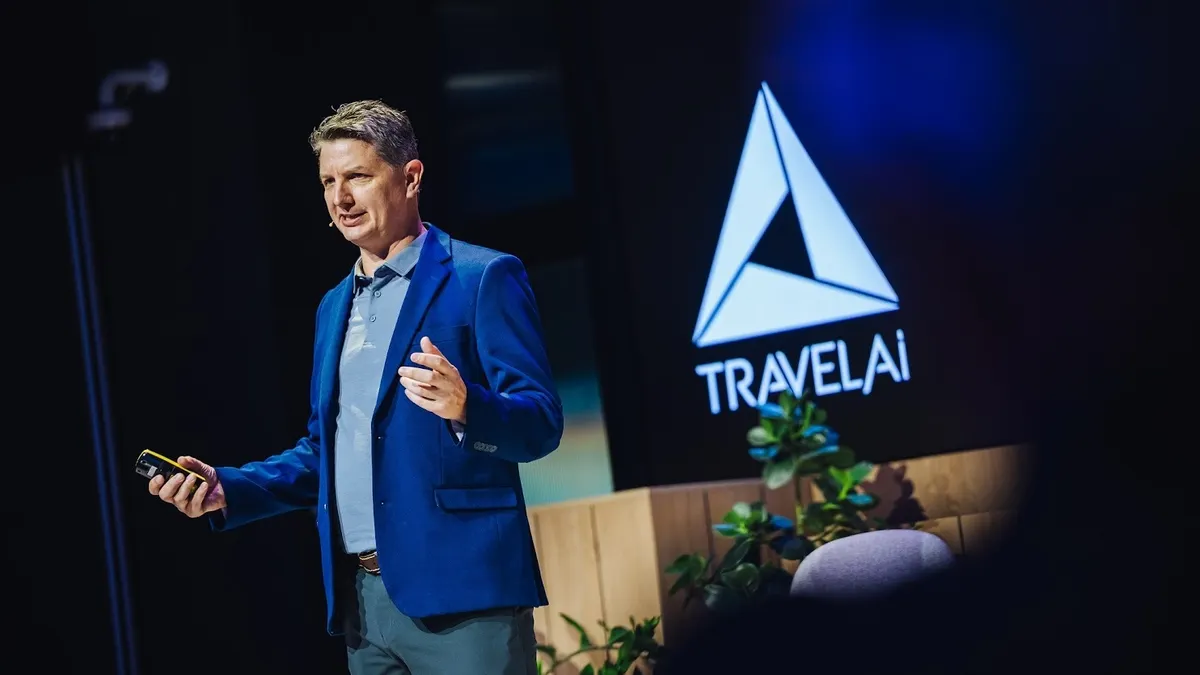
Last week’s news of the Sonder brand getting a second chapter caught some in the hospitality industry by surprise — especially because it’s taking a new form as an artificial intelligence-powered travel guide.
The original Sonder, which launched in 2014 as an apartment-style accommodations provider, met its demise in November 2025 following its terminated licensing agreement with partner Marriott International and subsequent bankruptcy filing. While hospitality companies such as Kasa have taken over some Sonder properties, the name itself still carries weight among travelers, despite its failure as an operator.
In fact, Sonder had put millions toward its marketing strategy while in business, according to John Lyotier, co-founder and CEO of TravelAI, resulting in “residual traffic and residual brand value.”
It’s also a big reason why Vancouver-based TravelAI decided to acquire Sonder’s brand and intellectual property and relaunched Sonder.com as an AI-powered urban stay guide.
Hotel Dive spoke with Lyotier to learn more about TravelAI’s future plans for Sonder, why he’s betting on the brand and where he thinks AI and travel planning are headed.
This interview has been edited for clarity and brevity.
HOTEL DIVE: Why did TravelAI buy the Sonder name? Do you think the brand still holds weight?
JOHN LYOTIER: I have always been a fan of Sonder — I thought they had an incredible brand and incredible product, and it was a real shame when things collapsed on their side.
"Many people didn’t even realize what actually happened to Sonder, and therefore they’re still searching for Sonder."

John Lyotier
TravelAI CEO and co-founder
When we were on the lookout for an urban brand, we didn’t have much presence in urban markets across the rest of our network. We were largely focused on accommodations that were beach destinations or mountain destinations and things that are much more short-term-vacation rental-centric. When the important news from Sonder came out, I started turning to one of my colleagues and said that we’re going to buy that, and we laughed at the time. But for me, it was kind of a perfect example of what we might do.
To go back to why we bought it, there’s definitely residual traffic and residual brand value. I saw a report in 2024 that $84 million was spent on sales and marketing by the organization. The previous group put a lot of money into the brand and marketing, and that part didn’t collapse completely when they went into receivership and into bankruptcy last year, so that brand still has value. Many people didn’t even realize what actually happened to Sonder, and therefore they’re still searching for Sonder.
We’re able to go forward with a very similar brand that is design-centric, tech-forward, and put something out to the community that says: “Hey, the Sonder that you love is not the same operating entity or company, but we can help you find the same place that felt like Sonder, thanks to our technology.”
Was the plan always just to buy the Sonder name? Not its properties?
Yes it was. We don’t operate physical real estate — that’s some other people’s game. We’re not hoteliers; there’s people who are experts at that.
Our group has always been really good at the distribution and marketing side, and we’ll let others be owner-operators. We have a lot more fun and experience operating heavily in the digital world, not the physical world.
“The industry is thinking AI is going to solve everything, but the biggest thing you can solve is: Can it give you a great traveler experience? Can you put humanity into the machine?”
John Lyotier
TravelAI CEO and co-founder
How much did you acquire the brand and IP for?
We have a lot of people asking, and what I’m saying is that we feel we got big value for it. I have some pretty aggressive targets for the brand. I think we can get up to $100 million in gross booking value on the brand in the next 12 months, but we’ll be able to get payback measured in months, not years. We think it’s good value for the asset. Just from the response we received in the first 72 hours, I think other people think so as well.
Could you walk me through what happens when you go on Sonder.com now? What is TravelAI doing to power it?
Our big belief is distribution. Distribution for us is we can go and find travelers who have high intent, but distribution only goes so far as a traveler’s memory. For us, we are really focusing on the memory infrastructure. As a traveler, you have your own restraints, desires, wants, your persona, all that information that makes you you. How do we capture and help you use that information to get a better experience across our site and eventually across the entire ecosystem?
We wanted to create this portable travel context, and so we have a project called traveler.md [a product that’s also integrated into Sonder.com], which allows you to plug in your information into Claude, into ChatGPT, into other AI agents, to help you personalize that traveler experience. For us, we think that memory is the most important thing in the agentic age. Can you ground your experience, whether you’re interacting with any of those platforms, any of those models — can you ground it in your travel behavior?
How does this memory infrastructure work exactly?
If you’re interacting with Sonder, we’ll start to personalize. We can find properties that are similar to your taste. The more information you put into it, the more that personalization occurs. If you wanted to save and store that, you save and store it on your own local [AI] system. But our system can extract that from you.
With travelers now increasingly turning toward AI for trip planning, what do you think is in store for the future of travel and AI?
I think there’s a couple of different things that hoteliers should really be paying attention to. There’s all this confusion or concern about travel shifting away from Google searches to ChatGPT searches. But at the end of the day, there’s still travelers taking real trips. The market they go to may change, and how you actually track them into your property may change. But at the end of the day, there's still a traveler there.
The industry is thinking AI is going to solve everything, but the biggest thing you can solve is: Can it give you a great traveler experience? Can you put humanity into the machine? One of the things to look at from all these technologies, whether it’s the one we’re building in our infrastructure, is how do you use that technology to improve the guest experience? And if you’re focusing there, you’ll have a better, happier guest. Everybody wins in that scenario.