

U.S. hotel investment activity is building momentum, with transaction volume reaching $22.2 billion through the third quarter, up 37% year over year, according to JLL’s U.S. Hotel Investment Market Update for Q3 2026 shared with Hotel Dive.
Transaction activity was fueled by a pivot toward bigger deals as well as an uptick in urban market deals, Dan Peek, Americas president of JLL’s Hotels & Hospitality Group, told Hotel Dive.
During the quarter, transactions increased 58% YOY to 928, including 12 single-asset trades above $1 million per key, up from four trades a year ago, per JLL. Meanwhile, single-asset deals rose 50% YOY to $20.4 billion.
“Despite the fact there’s a lot of high-profile resort transactions,” deals in Q3 skewed toward “highly amenitized urban hotels,” with favorable demand fundamentals also playing a role in shaping the investment market, Peek said.
Specifically, resorts made up nearly a third of single-asset deals in the quarter, while deals involving city and urban assets stood at nearly a quarter. Also of note is a shifting buyer pool, with high-net-worth individuals and private equity taking up a bigger slice of the pie.
JLL analysts also made predictions for the months ahead, forecasting that the hotel investment market is on the cusp of a new cycle. Investors are still getting their feet wet in a new, higher-rate environment.
Fundamentals ‘exceed expectations’
JLL’s report comes as hotel fundamentals continue to show signs of improvement, Peek said. U.S. RevPAR was up 5.6% year to date through September, with both occupancy and ADR strengthening, per the report.
“This year, the fundamentals have dramatically exceeded expectations,” Peek said. “Overall, we’ve seen a nice recovery on the urban side, particularly in some of the laggard markets.” These include Washington, D.C., and Boston, which are picking up in terms of investment activity, but still remain “behind the curve relatively.”
Meanwhile, the most active markets for investment in Q3 were Orlando, with $2.3 billion in total hotel transaction volume, with 17 trades; New York City at $1.5 billion, with 20 trades; and Naples, Florida, at $939 million, with five trades, per the report.
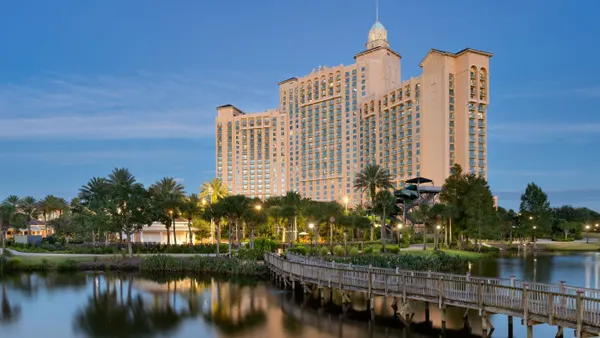
Major deals in the quarter included Trinity Investments’ sale of the Grande Lakes Orlando Resort in Florida, comprising a Ritz-Carlton and JW Marriott, for $1.38 billion; as well as Braemar Hotels & Resorts’ sale of the Ritz-Carlton Sarasota also in Florida.
Peek described deals in Q3 as “resort heavy,” with resorts making up 30% of single-asset hotel investment volume, compared to 18% in 2025. City and urban deals accounted for 23% of investment volume, while greater metro area and suburban assets made up 31%.
Due to improving hotel fundamentals, some owners have turned to recapitalization or refinancing their properties, rather than selling, Peek said. Despite higher interest rates, “there is a refinance solution for our space,” he said.
Luxury takeover
Despite some gains in upper upscale and upper midscale, luxury continues to be “the darling” of the industry amid a bifurcated market, Peek said. Year to date through September, luxury RevPAR rose 9.4% while upper midscale RevPAR increased 4.5%, per JLL.
“Given the fact that there's no new supply and the demand dynamic is what it is, we expect that [luxury] will continue to be strong,” Kevin Davis, Americas CEO of JLL Hotels & Hospitality Group, told Hotel Dive. Constrained development is expected to help the value of existing luxury properties and provide them with real pricing power, Peek added.
Moreover, transactions of more than $500 million comprised 15% of total volume, while “mid-sized transactions remain subdued.”
In Q3, private equity and high-net-worth individuals accounted for 42% of U.S. hotel investment volume, per JLL, which, earlier this year, predicted that private equity would be “back on the offense.” Of the 42%, private equity made up 24% of deals, while HNWIs represented 18%.
HNWIs, in particular, have had a notable impact on the market, especially with global wealth, including in the U.S., continuing to rise, Peek said. When private equity was less active, HNWIs, along with owner-operators, helped to fill in this gap. Additionally, the number of HNWIs has grown substantially over the past decade, with about 16% to 18% of these individuals comprising the current buyer pool, up from 1% about 10 years ago, he said.
Furthermore, real estate investment trusts have made a comeback and are “considerably more active” this year in part due to partial recovery in the stock market, according to Peek.
In terms of deal activity going forward, the hotel investment market is in “the midst of a new cycle, defined by a higher rate environment,” per Davis. Ever since the Federal Reserve first raised rates in March 2022, transaction activity has started to pick back up, and the market is still “acclimating to this new environment.”
“To me, all these things are signs of a new cycle, and it's almost like a new pair of shoes that we're just getting comfortable with,” Davis said. “We're kind of breaking them in, but we're really just starting to walk.”