

This article includes insights from Hotel Dive’s recent live event, “Lasting loyalty: Winning and keeping today’s customer.” You can watch the full event here.
As consumers’ spending habits change, they are seeking more out of their travel loyalty programs than just points and rewards, instead placing focus on experiences.
To meet those changing preferences, hospitality companies are finding ways to reach guests through experiential offerings that create value for guests throughout the entirety of their stay.
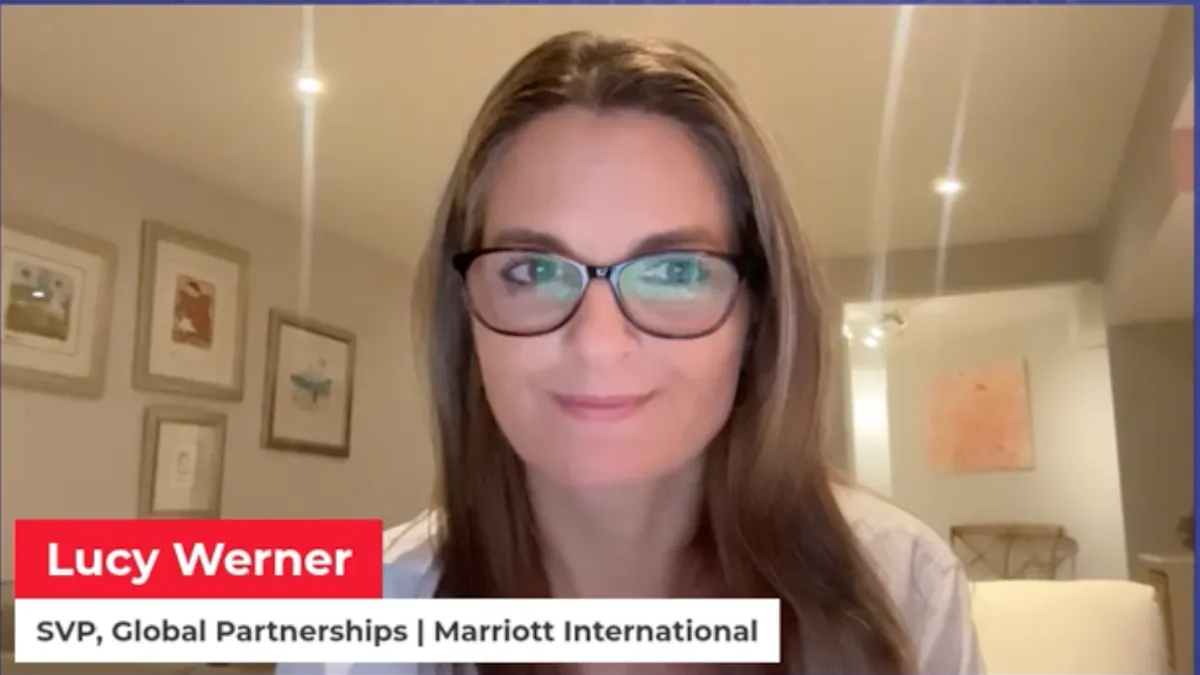
During a recent fireside chat hosted by Hotel Dive, Lucy Werner, senior vice president of global partnerships at Marriott International, shared more about the experiential loyalty landscape, including what’s driving changing traveler behavior and how brand partnerships can enhance the guest experience.
Adapting to guest preferences
According to Werner, the preference for experiential loyalty first began following the COVID-19 pandemic, when travelers began exploring “revenge travel” after being stuck at home.
“Coming out of COVID, we saw the beginning of revenge travel and people planning once-in-a-lifetime trips, and that trend has really sort of sustained,” she said.
A Marriott Bonvoy study from December 2025 found that about two-thirds of consumers planned to prioritize experiences over tangible purchases, a trend Werner said has continued well into 2026 as “consumers across the world are still traveling for experiences and passions.”
"When we're looking at partnerships, we're looking at it through the lens of what do our members love, and what are they traveling for, and then how we align that to the passions that the members have."

Lucy Werner
Senior Vice President of Global Partnerships at Marriott
Participation in the Marriott Bonvoy Moments platform, a loyalty program that allows members to use their points for VIP access to world-class events, has seen year-over-year growth, “well into the high teens” — a testament to the demand for experiences.
How partnerships can speak to guests’ passions
Werner also elaborated on what kinds of experiences Marriott offers to its guests as well as its approach to partnerships.
“When we're looking at partnerships, we're looking at it through the lens of what do our members love, and what are they traveling for, and then how we align that to the passions that the members have,” she said.
Marriott has partnered with sports organizations including Formula 1, the NFL, and the International Cricket Council. Earlier this year, Marriott partnered with Visa to provide access to every World Cup match and unique stay experiences.
“We really use these sponsorships not as logo placements, but essentially as brand platforms and providing access to members,” Werner said.
One of Marriott’s offerings called the “Sleepover Suite” transforms a sports suite at a stadium into a fully functional hotel room for one night, allowing guests to spend the night before the Super Bowl or World Cup final, for example.
“What we're seeing is that more and more there is a demand for travel around these events, and we are continuing pushing the boundaries of how we show up,” Werner said.
"I think within Bonvoy, it's essentially providing the platform and the currency that really helps build loyalty and embrace the customer where they're at."
Lucy Werner
Senior Vice President of Global Partnerships at Marriott
Marriott also attempts to “intersect the passions" through some of its airline partnerships, Werner said. Frequent United Airlines flyers who are also Marriott Bonvoy members have access to experiential dining events. Additionally, Bonvoy members can transfer Bonvoy points into airline miles, or convert airline miles into Bonvoy points.
“I think within Bonvoy, it's essentially providing the platform and the currency that really helps build loyalty and embrace the customer where they're at,” she said.
Marriott also considered its loyalty members at the Coachella music festival, which takes place each spring in California. To address the event’s pain points around transport and dining options, the company installed Postcard Cabins on site, where Bonvoy members could lounge as well as access the property’s food and beverage offerings.
Experiences throughout the stay
According to Werner, experiential loyalty offerings can be embedded throughout the guest journey, and not just as a redemption offering.
In addition to credit card partners including Visa, American Express and Chase, Marriott also has “everyday lifestyle partners.” These include rideshare apps like Uber, food and beverage partners like Starbucks, and retail car rental and cruise partners.
“Each brand has a specific DNA and a target audience, and so we really try to align the passions to those specific DNAs of the guests and purpose of travel."
Lucy Werner
Senior Vice President of Global Partnerships at Marriott
Partnering with Starbucks and Uber helps guests stay connected with Marriott’s ecosystem between trips, while also making the digital travel journey easier and more convenient for guests to navigate, including for when a flight gets delayed, Werner said.
Specific brand partnerships are also used to differentiate between brands and segments.
“Each brand has a specific DNA and a target audience, and so we really try to align the passions to those specific DNAs of the guests and purpose of travel,” she said.
For example, the Ritz-Carlton brand collaborated with a Madrid-based lifestyle brand Late Checkout on a clothing collection “designed for long nights and leisurely travel.” Werner said this partnership was a good fit for Ritz-Carlton’s “younger and trend-setting global audience.”
Additionally, Westin Hotels & Resorts teamed up with Goop, the lifestyle brand of celebrity Gwyneth Paltrow, for a digital series called “Sleep Training for Adults,” to help adult travelers improve their rest at home and on the road.
The future of experiential
Future experiential offerings at Marriott include more collaborations with The Coca-Cola Company, which recently became the hotel company’s preferred beverage partner.
“We're thinking through the brand portfolio that Coke has, and the portfolio of brands we have and how those brands actually come together,” Werner said. For example, Smartwater is owned by Coca-Cola, which presents opportunities for Marriott’s “renewed focus on health and wellness.”
The company is also aiming to adopt technology that will enable unattended retail and self-serve shopping at Marriott’s select-service properties. So far, Marriott has been able to test this concept through some of its partners.
Werner added that Marriott is also rethinking how to provide different experiences and different levels of access to its various guests, such as curating invite-only events to high-net-worth individuals.
Disclosure: DiveLive webinars are run by Informa TechTarget, the publisher behind Hotel Dive. Informa TechTarget has no influence over Hotel Dive’s coverage