

Dive Brief:
- CoStar and Tourism Economics significantly upgraded their U.S. hotel performance outlook for 2026, according to a Thursday news release.
- For full-year 2026, CoStar and Tourism Economics now expect U.S. RevPAR to increase 4.4% year over year, up from their previous 2.8% growth forecast. The pair also raised its outlook on occupancy and ADR, now expecting occupancy to stand at 63.1%, up from its previously projected 62.8%, and ADR to increase 3.1% year over year in 2026, as compared to 2%.
- The upgrade comes after U.S. hotels “outperformed our expectations on stronger leisure and business travel, fueled in part by the World Cup and America 250 celebrations,” Amanda Hite, president of CoStar subsidiary STR, said in a statement. CoStar and Tourism Economics also raised their U.S. hotel growth forecast for 2027.
Dive Insight:
The companies expect stronger performance results for 2026 after the U.S. hotel industry sold a record number of room nights in the first half of the year, representing an increase of 11.4 million compared to 2025, Hite said. Meanwhile, room revenue was up by more than $5.4 billion for the same period.
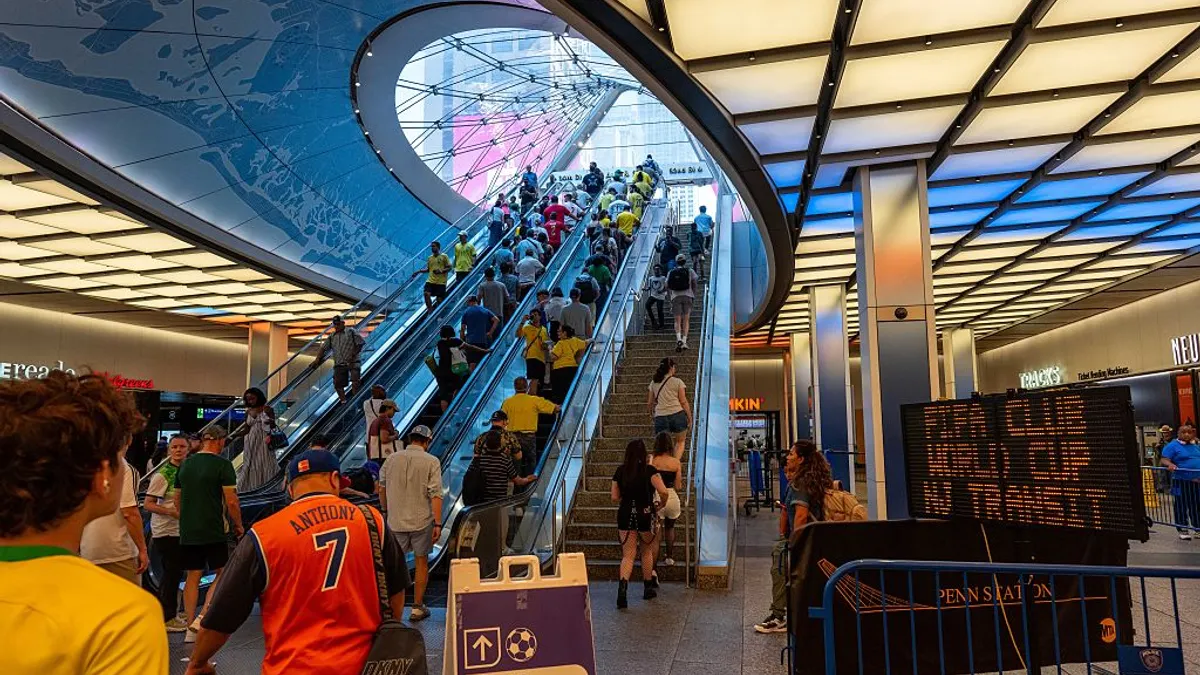
Despite initially weak hotel booking forecasts, the 2026 FIFA World Cup bolstered hotel performance in H1, Hite noted.
Looking at the back half of the year, CoStar and Tourism Economics expect slightly lower performance gains than in H1, but “top-line growth will still be driven by ADR,” Hite said. The pair also anticipates a stronger 2027 than initially projected.
CoStar and Tourism Economics now forecast that occupancy will stand at 63.4% in 2027 while ADR will increase 1.6% year over year, resulting in RevPAR growth of 2.1% for the full year.
“We expect travel activity to continue to grow as we move into next year,” Aran Ryan, director of industry studies with Tourism Economics, said in a statement. “Stable labor markets, recent wealth gains, and easing inflation should keep consumer spending resilient, while business investment is broadening beyond AI-related projects and group travel continues to recover.”
Despite the anticipated growth in 2027, “there will be some mid-year weakness due to difficult year-over-year comparisons,” Hite said.
Additionally, international visitation should see modest improvement, but prolonged U.S.-Canada trade tensions will remain a headwind to watch, Ryan said.
Another “worrisome” trend is rising expenses, which will increase by more than the rate of inflation in both 2026 and 2027, per Hite. Hospitality professionals have said rising operational expenses, including labor costs, are a top concern in 2026.