

The extended stay category has long been considered the darling of the hotel industry. Now, a rapidly expanding demand opportunity for the category is adding fuel to a fire that hospitality players thought was burning strong on its own.
That fuel is data center projects, which have cropped up across Texas, Virginia and Georgia over the last decade, and more recently have rapidly expanded into new and emerging U.S. markets.
As a form of infrastructure development, data center projects are driving notable extended stay demand nationwide, hospitality industry professionals shared. However, the projects’ lack of permanent workforce also raises questions about the sustainability of that demand.
To learn more about the unique extended stay growth opportunity brought on by the data center boom and how hotels are shifting their strategies to capitalize on it, Hotel Dive spoke with extended stay leaders from Choice Hotels International, Wyndham Hotels & Resorts and My Place Hotels.
A rapidly expanding opportunity
During the last decade, spending on data center construction in the U.S. has grown tremendously, and there are no signs of that slowing in the near term. Between 2024 and 2027, annual investment in data center infrastructure is expected to increase by 116%, from $53.2 billion to $118.4 billion, according to a May report from PwC.
For the hospitality industry, this “super cycle” of development will produce a significant amount of demand for the extended stay category, “particularly during the construction phase” to accommodate project workers, said Matt McElhare, vice president and extended stay segment lead at Choice Hotels.
Over the last couple of years, markets including Atlanta, Phoenix and Austin, Texas, have become hotspots for data center construction, he noted.
Mike Mueller, head of extended stay brands at Wyndham Hotels & Resorts, similarly expressed that Georgia, Texas and Virginia “have tons of data centers open already,” with growing pipelines. Pennsylvania and Illinois are also seeing an influx of data center projects, Mueller said, noting that extended stay demand will follow in those regions.
But so far, data center-driven extended stay demand has been limited for some hotel brands. In certain markets, My Place properties with proximity to a data center have seen demand upswings, while in others, the infrastructure projects have little to no impact on hotel demand, CEO Ryan Rivett told Hotel Dive.
“Much like an oil boom and bust, the faucet just shuts off one day and the demand attributable to those projects goes away, never to return."

Ryan Rivett
My Place Hotels CEO
McElhare similarly said that extended stay demand has been uneven in certain data center markets for Choice. The company has seen “massive [data center] clustering effects that speak to a very favorable multiyear demand forecast,” in some markets, while in others, long-term demand is “a little bit less certain.”
In markets with uncertain demand, Choice sees an opportunity to expand its extended stay conversion brands, which can quickly convert into an extended stay offering and take advantage of more immediate demand fundamentals, as compared to a new construction product that could take years to come online, McElhare said.
Rivett questioned whether extended stay demand produced from data center construction is sustainable long-term, given the centers don’t require a significant workforce to operate once completed.
“Much like an oil boom and bust, the faucet just shuts off one day and the demand attributable to those projects goes away, never to return,” Rivett said. Rivett added that he has yet to see proof that “data centers themselves perpetuate or catalyze population growth because they don’t require a significant workforce to operate.” If they did spur population growth, it would be a strong signal of sustainable hotel demand.
Rivett noted that because data centers pay substantial taxes, they have the potential to stimulate reinvestment in infrastructure and other public projects or development incentives, “but it’s very difficult to get confident that that’s actually going to happen.”
Is demand sustainable?
However, Mueller argues that data center-driven extended stay demand doesn’t dry up overnight when a project wraps; rather, it takes a new shape. According to Wyndham’s Mueller, data center projects can drive population growth — or “suburban sprawl” as he calls it — in turn, sustaining extended stay hotel demand long-term.
Data center construction creates a pipeline of regional development, Mueller explained. While a data center may not have a substantial permanent workforce, there will be ongoing maintenance and management teams handling the facility. This, coupled with jobs created through the energy infrastructure development that powers these centers, results in residential development for the surrounding market, he said.
A residential development boom could lead to the development of medical centers or other necessary community spaces in a given market, bringing in another core demand driver for extended stay hotels, Mueller said.
Meanwhile, Choice’s McElhare pointed out that a market with one data center will have the grid and infrastructure upgrades as well as the regulatory and policy framework in place to support additional data center projects, which could lead to a “flywheel clustering effect.”
“If you think about the cooling systems, HVAC systems, turbines, the switch gears and electrical generation equipment that go into these data centers, each one of those has a manufacturing hub that is likely going to experience rapid expansion over the next five to 10 years."
Matt McElhare
Vice President and Extended Stay Segment Lead at Choice Hotels
A clustering of data centers in a given market, particularly as those projects will have staggering construction phases, “does actually create sustainable high demand, which is attractive to a hotel developer,” McElhare said. He noted that Choice has started to see data center projects clustering in several markets across the country.
Top growth markets
One of those markets is the Dallas-Fort Worth area, McElhare said. Given the region’s recent data center growth, JLL projected earlier this year that Texas could overtake Virginia as the largest global data center market by 2030.
While Choice already has a significant extended stay presence surrounding Dallas, there is room to add additional supply, McElhare said. The company has also identified Columbus, Ohio, as a “market that is seeing a lot of data center-driven growth,” McElhare said.
Wyndham also has a growing extended stay footprint in the Dallas metroplex, which is a “really up-and-coming data center area,” Mueller said. The company is expanding elsewhere in the state, including on the periphery of Austin and Houston, he noted. Northern Virginia and the surrounding Atlanta metro are other top markets where Wyndham sees growth opportunities.
“These places all have workforce availability, infrastructure availability, but more importantly, they have land opportunity,” Mueller said.
When looking to potentially expand in a market where a data center is in progress or pending, My Place evaluates its potential a little differently. The company will look back three to five years to assess how population growth, commerce and supply and demand trends have changed over time, Rivett said.
According to Rivett, My Place asks, “Can we make a correlation between commerce growth, rooftop growth, population growth and a need for additional supply?” In many markets, however, Rivett has not been able to make that correlation, he said.
For Choice, a market’s “cluster strength,” or the “economic gravity that a data center can produce,” comes into play, according to McElhare. Choice evaluates whether an existing data center project will bring utility investment to the market; if it will spur additional data center builds; and if other power-intensive or infrastructure-dependent businesses will be attracted to the region and bring more construction worker demand.
Choice is also targeting “second order impact” markets, which act as key nodes within the data center supply chain, McElhare said.
“If you think about the cooling systems, HVAC systems, turbines, the switch gears and electrical generation equipment that go into these data centers, each one of those has a manufacturing hub that is likely going to experience rapid expansion over the next five to 10 years, and we're looking at those markets as well,” McElhare said, noting that these are where Choice sees “the most competitive advantage” among extended stay rivals.
Charlotte and Raleigh, North Carolina, are two key examples of these markets, McElhare said, noting larger industrial conglomerates have recently built new capacity in the region.
“We were already building extended hotels [in those areas], but they just got a lot more attractive because of this wave,” McElhare said.
‘Broadly segmented’ demand
When it comes to what type of extended stay hotels are best suited for data center markets, the pros agree that data center construction drives demand across segments.
Hotel demand from data center construction teams is “broadly segmented,” as both blue- and white-collar workers come into town to support these projects, and they have different accommodation needs, Rivett said.
To meet this demand, there is a white space opportunity in the luxury segment, Mueller said, explaining that expats working on U.S. data center projects typically demand a more upscale experience. Because of this, Wyndham is evaluating growth opportunities for its upscale extended stay brand with residential hospitality manager Reside.
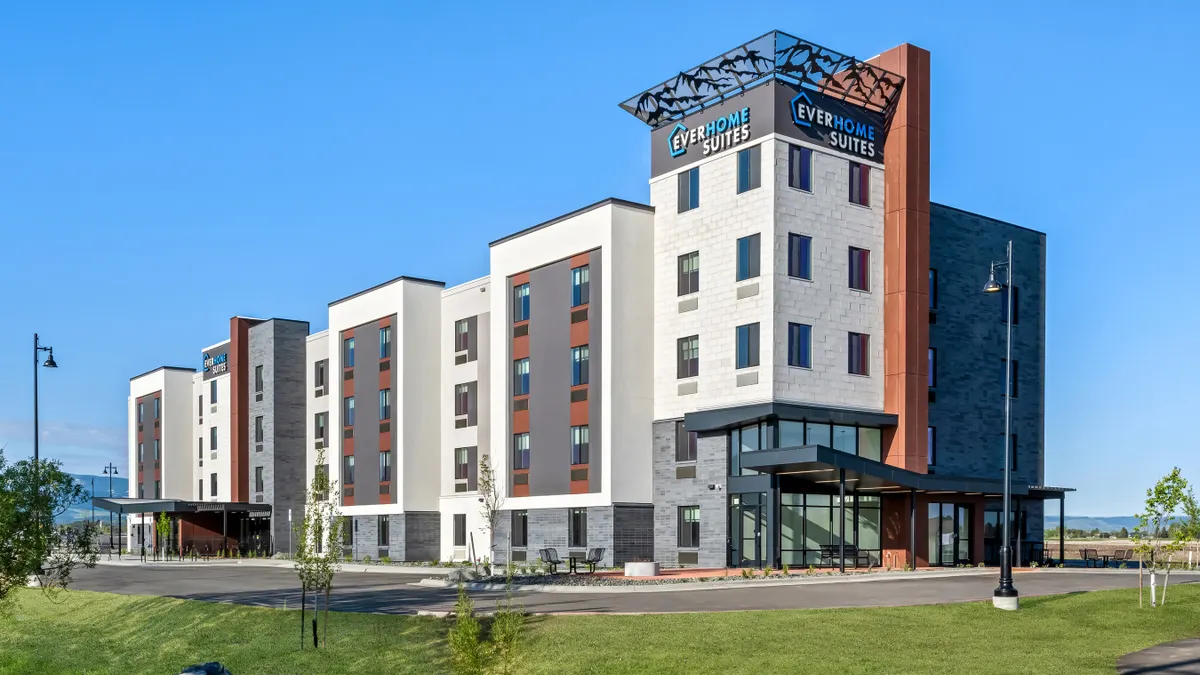
Meanwhile, Choice’s Everhome Suites product is best suited for data center markets, as it meets demand by “gray collar project workforce travelers,” McElhare said. A gray-collar worker is an employee whose role blends both white- and blue-collar skills.
Those types of guests prefer to stay in an accommodation that is a little higher-end without the price tag of an upper midscale or upscale hotel, he explained.
He said Everhome Suites offers affordable rates that are attractive to longer-stay customers, while also providing a higher-quality product that allows guests to stay in their rhythm with access to on-site amenities and in-room fundamentals, such as a kitchen and laundry.
“The highest opportunity white space within extended stay is high-quality, midscale [hotels] because most of the supply that was built in that space is at least 15 to 20 years old, and that's where Everhome is designed to fit,” McElhare continued.
Still, in many cases, “true long-term stay guests related to the data centers aren’t necessarily filling up the hotels,” Rivett said, noting that many workers will choose to rent multifamily or single-family homes in the area.
Regardless, data center construction has the potential to be a significant opportunity for extended stay hotels in the near and long term, provided sustainable demand patterns exist within a given market. These demand patterns are the impetus for developer caution or bullishness.