The following is a guest post from Fabio Zaniboni, founder and CEO at BubblyNet. Opinions are the author’s own.
For too long, automation in the hotel industry has been relegated to the back office, seen as a purely technical tool for managing HVAC systems or dimming lights to meet energy codes.
This view treats automation as an afterthought — a line item in the operational budget introduced late in the design process. But this perspective fundamentally misunderstands its potential. When automation is woven into hotel design from the beginning, it ceases to be a mere utility and becomes a powerful creative medium, capable of crafting dynamic, responsive and deeply personal guest experiences.
Treating automation as a last-minute addition not only limits its creative power but also curtails its ability to maximize guest satisfaction, achieve ambitious sustainability goals and ultimately boost return on investment. By bringing the Internet of Things and automation into the initial design narrative, hotels can move beyond static interiors and create environments that live, breathe and adapt in real-time.
From static rooms to responsive environments
The true potential of automation lies in its ability to transform a hotel from a collection of static spaces into a responsive environment that caters to the well-being of its guests. This begins with understanding that a guest’s needs change throughout the day. Automation allows a hotel’s design to change right along with them, adding a fourth dimension — time — to the architectural vision.
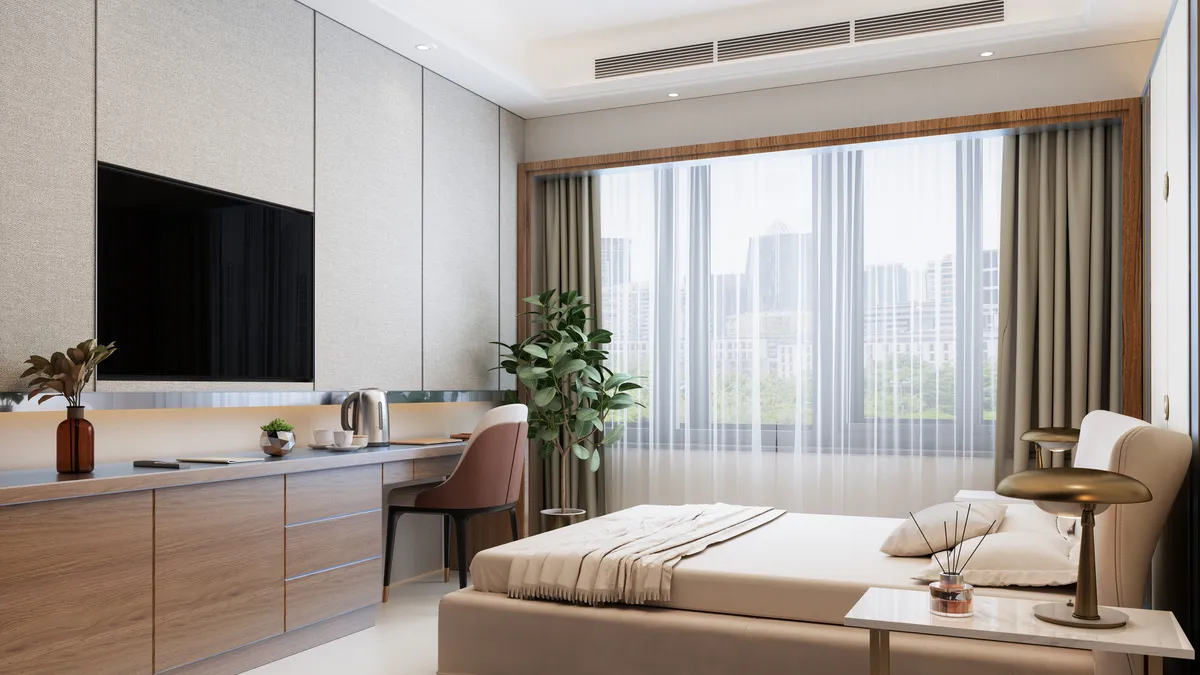
Imagine a guest room that wakes up with the sun. As morning light filters in, an automated system can orchestrate a “wake-up scene”: The blackout curtains slowly open, interior lights gradually brighten to mimic the dawn and the temperature adjusts to a comfortable level. This isn’t just about convenience, it’s about aligning the environment with the guest’s natural circadian rhythm.
Smart lighting systems can be programmed to shift in color temperature and intensity throughout the day, from cool, energizing light in the morning to warm, relaxing tones in the evening, promoting better sleep and reducing fatigue.
This concept extends to public spaces as well. A hotel lobby can transition from a bright, bustling hub during daytime check-ins to a tranquil, intimately lit lounge in the evening. Automation allows designers to program these transitions seamlessly, ensuring the ambiance always feels intentional and curated.
Air quality is another critical component of well-being that automation can dynamically manage. IoT sensors can continuously monitor CO2 levels, humidity and airborne pollutants, automatically adjusting ventilation systems to ensure the air remains fresh and healthy.
High CO2 levels have been shown to cause drowsiness and reduce cognitive function, directly impacting a guest’s comfort and experience. By proactively managing air quality, hotels demonstrate a tangible commitment to guest health, a factor that is increasingly influencing traveler choices.
The symphony of the senses: crafting multi-sensory experiences
A truly immersive hotel experience engages all the senses. Automation is the conductor that can orchestrate a symphony of light, sound and even scent to create multisensory
moments that surprise and delight guests. This goes far beyond simple dimming. It’s about creating a narrative.
Consider the Aria Resort & Casino in Las Vegas, which uses automation to create a highly personalized arrival experience. When a guest first enters their room, the curtains part to reveal a stunning view of the city, the lights turn on, and the television displays a welcome message. This single, coordinated moment sets the tone for a luxurious and high-tech stay.
This concept can be taken even further. With integrated IoT systems, a hotel could offer curated “scenes” that guests can select from a tablet or app. A “Relax” scene might dim the lights to a warm glow, play calming ambient music and even activate a subtle, soothing fragrance through a connected diffuser. A “Focus” scene, ideal for business travelers, could optimize lighting for work and use sound masking technology to minimize distractions. For instance, research shows that sound masking can improve focus and reduce distractions, a principle just as applicable to a guest room as an office.
These details — the gentle transition of a dimming curve, the silent glide of motorized shades, the perfect synchronization of light and sound — are what elevate a stay from memorable to unforgettable. They demonstrate a level of thoughtful design that feels both luxurious and intuitive.