Dive Brief:
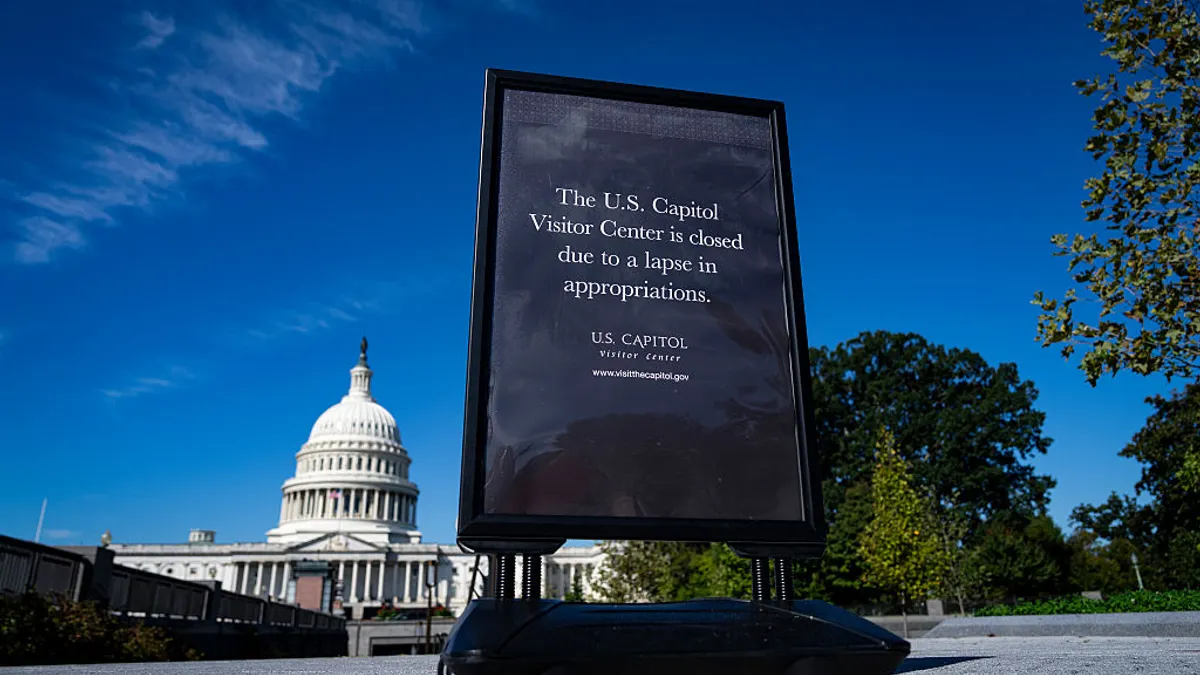
- Travel and related sectors suffered $6.1 billion in total economic losses as a result of the 43-day U.S. government shutdown, which lasted from Oct. 1 through Nov. 12, 2025, according to a Wednesday release from the U.S. Travel Association.
- In partnership with Tourism Economics, U.S. Travel analyzed data and found that, on average, the U.S. saw more than 88,000 fewer trips per day, which resulted in a direct loss of $61.5 million in travel spending per day, per the official report. The combined total daily loss of both indirect and induced effects averaged $136.8 million.
- The shutdown’s impact caused a reduction in travel activity, resulting in direct trip-related losses of $2.7 billion, a spending loss equivalent to a 1.7% reduction in total U.S. travel spending during the shutdown period, per the report.
Dive Insight:
The economic losses and travel reduction were “a clear signal of how quickly uncertainty and disruption suppress travel activity,” U.S. Travel said in the release.
“The takeaway is clear: government shutdowns are costly, disruptive and unnecessary,” the report stated, adding that shutdowns “disproportionately harm a sector that supports 15 million jobs and underpins America’s economic growth.”
The shutdown resulted in an estimated $650 million in lost hotel business as of Oct. 22, when more than 30 hospitality industry associations sent a letter to the U.S. House of Representatives and Senate urging them to end the shutdown. In the letter, the American Hotel & Lodging Association said that with each day of the shutdown, the U.S. economy would lose another $31 million “in activity that would’ve been generated by hotel stays.”
In early November, 38 days into the shutdown, the total cost of lost hotel business was equivalent to approximately $1.18 billion.
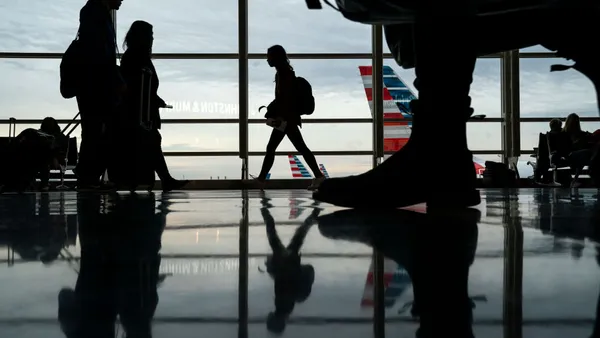
Based on estimates from the U.S. Travel and Tourism Economics report, the shutdown reduced air passenger activity by 1.3% and reduced trip activity related to attractions such as national parks by about 5%. In addition, it cut government-related travel by more than half.
“Shutdowns also suppress travel demand,” U.S. Travel said in the release. “These effects ripple outward, decreasing visitor spending and imposing downstream costs on airlines, hotels, restaurants, small businesses and local economies.”