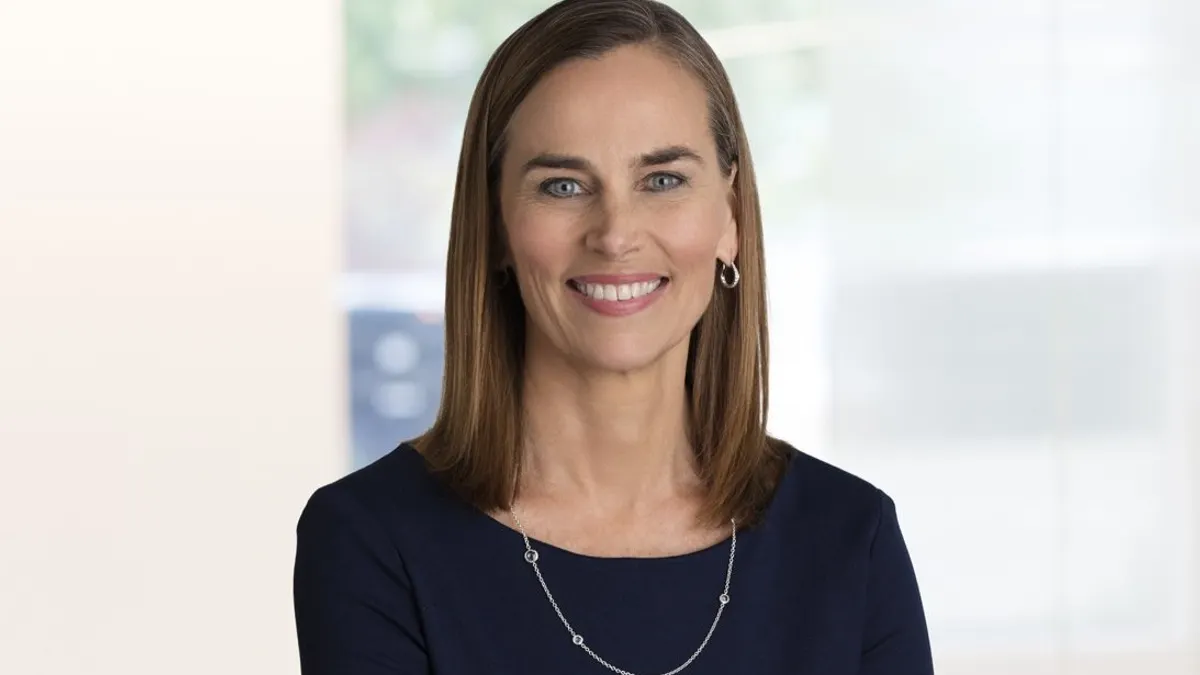
Marriott International Chief Financial Officer and Executive Vice President of Development Leeny Oberg is retiring this month after 26 years at the company, the last decade of which she spent in the CFO role.
Oberg’s career has been marked by defining events, including multiple economic downturns, that have fundamentally and structurally shifted travel and hospitality. The evolution of technology has also significantly shaped the industry, and, in turn, her work at Marriott, she told Hotel Dive.
In a one-on-one interview, Oberg reflected on her career and lessons learned along the way, giving advice for her successors and longtime Marriott veterans Jen Mason and Shawn Hill. She also shared more about Marriott’s imminent technology transformation and its strategy to expand its portfolio across segments.
This interview has been edited for clarity and brevity.
HOTEL DIVE: As you reflect on the last 10 years as CFO, what company milestones or professional accomplishments stand out?
LEENY OBERG: Broadly, something that has shaped the last 10 years in my work is the reality that travel has continued to grow in popularity. When you think about the expenditures in travel and tourism growing faster than GDP in most markets around the world, it is great for our business. Technology has been a driving force in these trends.
During my tenure, a couple of big transformations for Marriott that come to mind are the acquisition of Starwood [in 2016]. It was a really incredible change for the company and great expansion as we thought about our global presence around the world. It also resulted in the creation of Marriott Bonvoy out of the two loyalty programs, which has given us a platform for communicating with our guests in a really meaningful way.
The last decade has been marked by significant challenges, maybe most notably the pandemic. How has the hotel industry changed over this period, and what are lessons you’ve learned along the way?
First and foremost, COVID reminded people not to take travel for granted. During the pandemic, I think there was an even greater appreciation for the benefits of travel. Whether it was to see family and friends, to explore new places and new cultures, or just the basics of a business trip, there was a real reminder after the pandemic of how important those things were to people.
One of the things that I’ve noticed over my career is that human beings’ habits are very resilient. So whether it was the Great Recession or COVID, once people moved beyond the crisis itself, it was amazing how they picked right back up and went back to living their lives and going after what they wanted to do and how they wanted to spend their money.
When I think about the key lessons learned, certainly during the pandemic, the easiest one to point to is that time is of the essence in a crisis — being able to pull things together quickly and have the team focus very squarely on the top priority. I saw that play out in real time, in a way that, frankly, personally, was incredibly rewarding because of how we were able to help the company and our owners get through it.
It was extraordinary to watch that, despite people’s own personal challenges in their communities and with their families, they were willing to contribute to the cause of helping the company get through the pandemic and be even stronger on the other side. When everyone got their eyes on the same ball, what we could do together and how quickly we could do it, was far more than I anticipated.
Another lesson I’ve learned is that, with the way technology is, time is critical. Being first to the market with an innovation or with something that is of great interest to the customers and watching something go viral can be a whole other avenue to building your brand and being successful, because we all know that when something goes viral, it is because people find it interesting and want to spread the word, and that’s quite powerful.
What is an innovation that Marriott is on the cusp of?
We are starting to fully roll out a tech transformation across our property management systems, our loyalty platform and our reservation system that will be dramatically better for all of our constituencies. It will be better for the associates in terms of an easier process to operate. There will be a much better reservation system in terms of different ways to merchandise different kinds of properties and rooms in various categories. And from the customer standpoint, there will be a better way to communicate with us. We are in the process of getting meaningful numbers of hotels on board after extensive testing over the last quarter of 2025, so we’re very excited about that.
Additionally, we’ve expanded over the past couple years into the midscale segment globally, as well as took the opportunity to do unique acquisitions of the City Express and CitizenM brands and successfully integrate them into our system. This has been a clear demonstration of how we want to make sure that, for all price points, for all trip needs and for as many locations as we can possibly create for our guests, we really want to be the travel answer for our customers. Those growth opportunities are in addition to growing our existing brands, including our collection brands.
What advice would you give to your successors as they navigate the ever-evolving industry?
Breadth and depth are key. We all want to do the particulars of our job really well, but as you move through a career, having exposure to other areas and other pieces of the business — that combination of both broadening your knowledge of the company and doing the particulars of a job — are both really important as you work your way through your career.
I also feel strongly about the need to develop talent, so that would be one area that I would emphasize with my successors. And analyzing a situation and then making decisions and moving forward is critical, because you can stew and stew, but at the end of the day, you actually do the most — even if you make mistakes — by being decisive and moving forward.
COVID is the biggest staring-in-your-face example, where come Friday, March 13, 2020, we were looking at revenues dropping nearly 100% for our hotels as the U.S. practically shut down. The reality is we had to make a number of decisions extremely quickly to try to hold on to whatever cash flow the hotels could keep. And while we clearly didn’t have time to study every ramification of every decision, we needed to move forward immediately and then adjust as we went forward.
I think that experience demonstrated how much that can help, because time is your enemy in a period of severe cash crunch. The quicker you can make decisions and then adjust as needed quickly is the best way to move through it.
How have you fostered genuine connection and transparency not only across Marriott’s corporate teams, but with owners, shareholders and professionals industrywide?
I love my work. I enjoy all the pieces of it. And I do think at the end of the day, your team recognizes that spirit and that desire to do better and find new things that can be helpful, and it makes it more fun.