The following is a guest post from Filip Linek, the founder and CEO of FLAE Robotics. Opinions are the author’s own.
The idea of humanoid, artificial intelligence-powered agents serving in hotels remains largely futuristic, but the technology is steadily advancing toward a practical reality.
As hotels grapple with rising competition and escalating guest expectations, these machines are set to shift from novelty to necessity, redefining service, boosting efficiency and shaping brand identities. Recent research suggests that travelers are increasingly open to encounters with AI at reception, signaling a fundamental change in what consumers now value.
For forward-looking hoteliers, adopting AI-powered agents is a strategic move to enhance guest satisfaction and stay ahead in a rapidly evolving hospitality landscape.
Why is this transformation happening now?
Advances in AI, natural language processing (NLP) and robotics are enabling smarter automation and more precise personalization, addressing soaring labor costs, chronic staff shortages and growing guest demands for faster, frictionless service.
Investment in AI surged 250% in 2025 compared with the previous year, with 42% of hospitality firms spending between $1 million and $5 million on the technology. Yet many remain cautious, with nearly 60% expressing concerns about trust and accuracy.
Early adopters are embracing AI to optimize staffing, automate routine tasks and deliver scalable, data-driven experiences, while others are carefully weighing implementation risks in an industry that’s constantly evolving. This moment represents a critical shift, where AI moves from being a novelty to an essential tool for hotels seeking to survive and grow in an increasingly competitive market.
How AI is reshaping hotel operations and staff roles
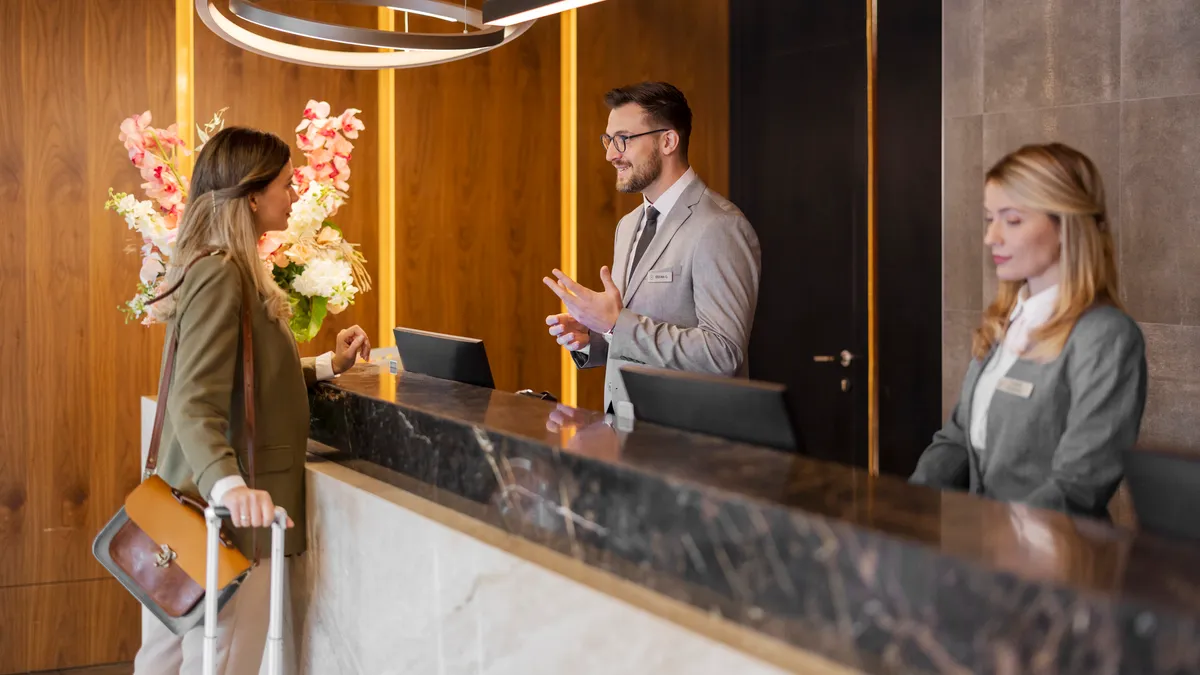
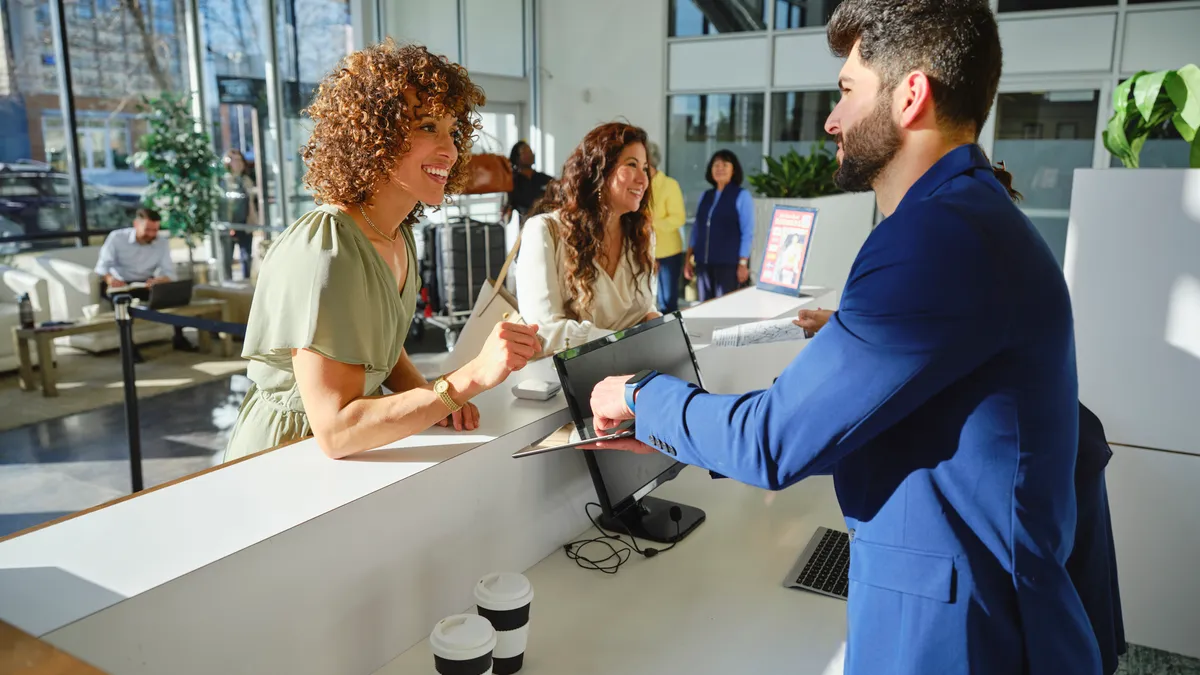
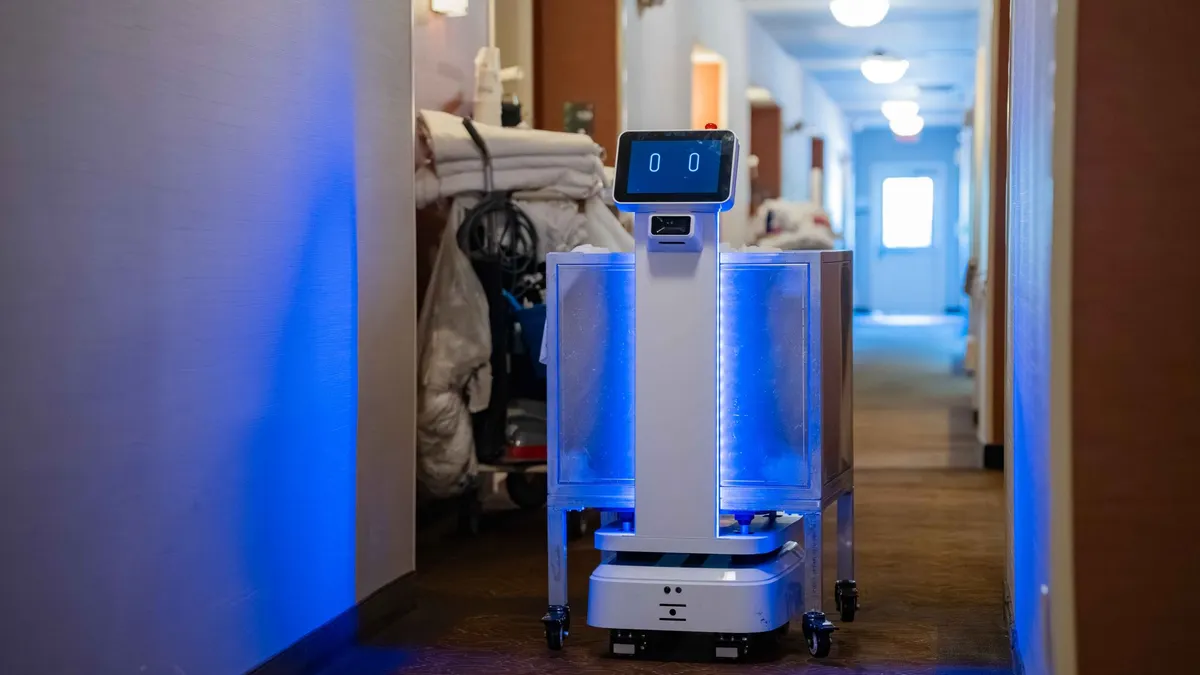
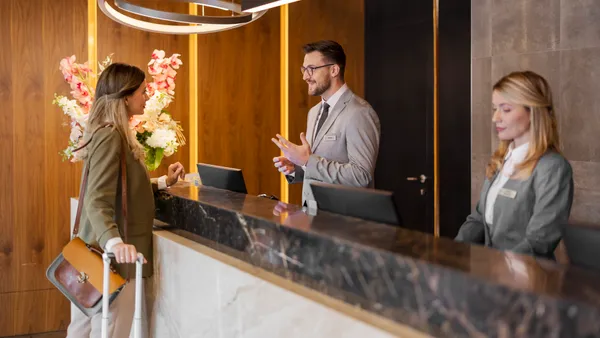
AI-powered agents can take over routine tasks like check-in, key card activation, luggage guidance and answering common questions about the hotel’s location. This helps reduce delays during busy periods and allows human staff to focus on more complex issues, resolving conflicts and providing the personal touch where emotional intelligence matters most.
Defining your brand in a technology-driven hospitality world
In a competitive landscape where guests often choose based on tech‑forward amenities, having a humanoid AI agent in the lobby is as much a branding statement as it is a service tool. These AI agents become part of the guest’s story — filmed in social feeds, mentioned in reviews and remembered long after checkout. That organic visibility acts as free marketing, helping properties stand out without costly media buys.
Assessing staffing and operational workflows
Start with a granular look at your current guest journey, from pre‑arrival to checkout. Which processes are bottlenecks? Which interactions do guests complain about most? Which tasks eat up the most staff time without adding much perceived value? These are the prime candidates for automation.
Mapping this out also helps protect human‑touch moments: the warm welcome, the problem‑solving conversation, the unique local recommendation. By designing for collaboration between humans and machines from day one, you avoid both redundancy and service gaps.
Building a resilient tech backbone
Even the most advanced humanoid AI will stumble if it’s sitting on weak infrastructure.
Future‑ready hotels need: high‑bandwidth Wi‑Fi and network resilience to handle constant data exchange between AI agents, PMS platforms and cloud AI engines; enterprise‑grade cybersecurity to protect guest data and comply with GDPR or equivalent regulations; and integration capability so AI agents can access live reservation details, room availability, billing systems and loyalty program data for contextual conversations and actions.
Hotels should also consider deploying edge‑computing solutions where applicable to reduce latency in high‑volume guest interactions.
Preparing staff to work alongside AI
Employees need to know how to work alongside a humanoid AI agent, from redirecting guests to letting the AI agent handle certain queries to troubleshooting on the spot. The right training reframes AI agents from competitors to colleagues that lift low‑value workload off their shoulders. This engagement is critical to adoption and to avoid silent resistance from frontline teams.
Showcasing technology as part of the guest experience
Don’t let AI agents feel hidden or awkward. Feature them proudly in marketing. Promote them on your hotel’s website and social media. Encourage guests to interact, take a selfie, ask it a question and use it for local tips. The more it’s embraced as part of the brand rather than a back‑office experiment, the more positive buzz it generates.
Piloting new ideas, measuring results and making improvements
Rolling out humanoid AI should be similar to launching a new service brand: test it in one property or one department first. Monitor not just technical performance, but also guest reaction, staff satisfaction and ROI. Refine the AI agent’s scripts, workflows and integrations before expanding. In a hospitality context, “working” doesn’t just mean the AI agent functions; it means guests feel their experience has improved.
Forward-thinking hoteliers are beginning to explore how integrating AI agents can complement human-centered hospitality rather than replace it. As the technology matures, the strategic adoption of humanoid AI agents will become increasingly important for hotels aiming to meet rising guest expectations and stand out in a competitive market. Ultimately, success in hospitality will depend on balancing innovation with the personal touch that travelers continue to value.