Dive Brief:
- The Global Business Travel Association is urging the U.S. government to reconsider its suspension of the Global Entry program, warning it could disrupt business and leisure travel as well as increase security and operational risks at airports, according to a letter sent to congressional leaders Thursday.
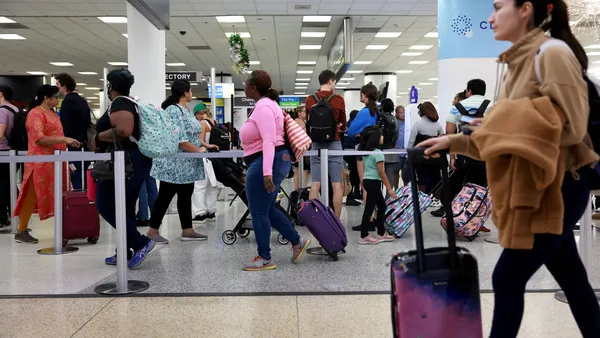
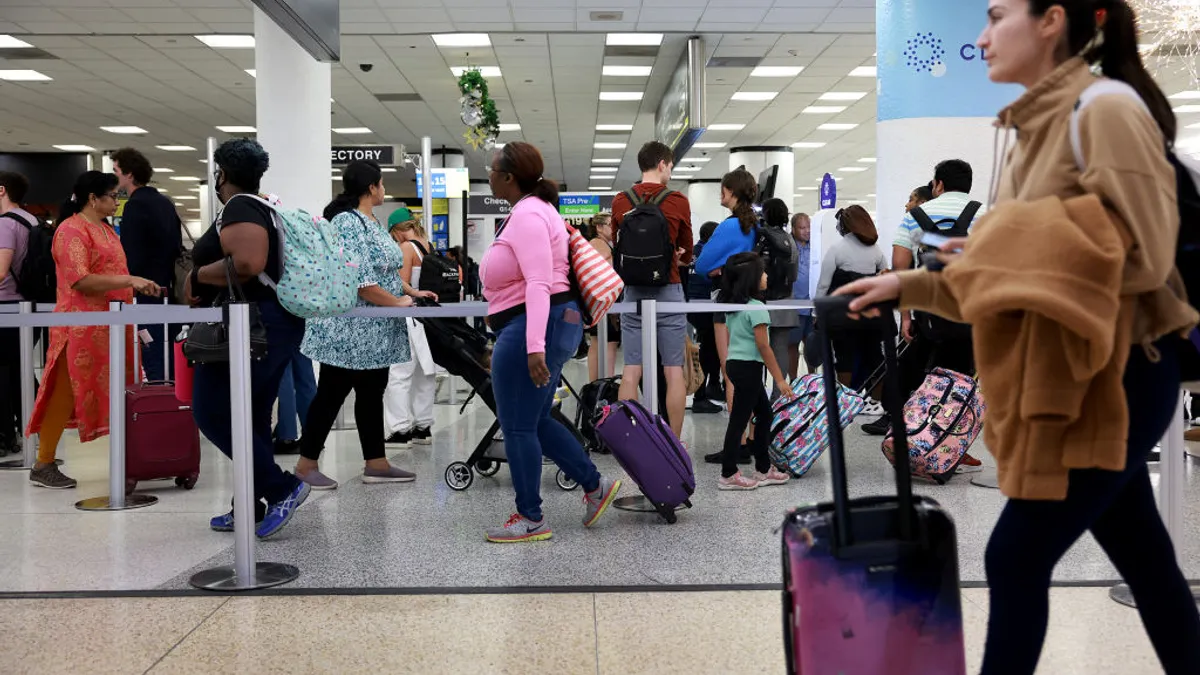
- As a result of the partial government shutdown, which began Feb. 14, the Department of Homeland Security suspended its Global Entry program starting Feb. 22, as an emergency measure to “preserve limited funds and personnel.” According to the U.S. Customs and Border Protection agency, more than 13 million people use the program, which allows pre-approved travelers to skip the customs lines and use kiosks for faster entry into the country.
- GBTA, which represents more than 9,000 members, claims that suspending Global Entry disrupts the corporate travel ecosystem “at a time when companies rely on efficient travel to meet clients, manage operations, and support global commerce,” per the news release. Government shutdowns in the last year have also negatively impacted hotel performance.
Dive Insight:
In a news release accompanying the letter, Alexandria, Virginia-based GBTA emphasized the suspension’s potential “widespread and material consequences,” including strain on supply chains and weakened economic competitiveness. Furthermore, “U.S. companies and their employee travelers would feel those impacts immediately,” GBTA CEO Suzanne Neufang said in a statement. “Longer lines, diverted security focus, and lost productivity would be the real cost of suspending these programs.”
The U.S. Travel Association issued a similar statement on Tuesday, calling for DHS to reinstate the Global Entry program immediately and to stop using travelers as “leverage to achieve a political outcome.”
The Washington, D.C.-based group said suspending Global Entry doesn’t just slow lines, “It increases costs and strips away a layer of security infrastructure that took years to build.”
Initially, the DHS had also suspended the Transportation Security Administration's PreCheck program, along with Global Entry, but quickly reversed that decision. PreCheck now remains operational in part due to strong backlash.
Recent government shutdowns have caused air travel disruptions that trickle down to the hospitality industry. As a result of the 43-day shutdown in October — the longest-running in U.S. history— travel and related sectors incurred an estimated $6.1 billion in total economic losses. As of Oct. 22, hotels lost about $650 million in business, which would have been generated by bookings, according to the American Hotel & Lodging Association.
Additionally, many hotel groups said the government shutdown negatively impacted fourth-quarter earnings, with widespread declines in U.S. RevPAR. In Q4, Hilton reported that U.S. RevPAR dropped by 1.6% due to adverse effects across business, group and transient travel from the “prolonged government shutdown.” Marriott International and Choice Hotels also attributed Q4 performance declines to softer government and international inbound demand, resulting from the shutdown.
U.S. business travel spending is projected to reach $395.4 billion this year, making the country a top market worldwide, per GBTA research. Domestic business travel has contributed nearly $421 billion annually in direct spending and supported six million jobs, “underscoring how critical efficient travel is to economic growth and competitiveness.”
Despite dampened business travel in 2025 due to economic uncertainty and political tension, U.S. hotels still stand to benefit from business travel. A December report from Morgan Stanley found that corporate travel budgets are projected to rise by 5% year over year globally in 2026, and hotel bookings are predicted to increase 6.3%, with room rates up 3.9%.